
What a great response we had Saturday for the unveiling of the new museum theatre program! We even had to add a fourth show for visitors because it was so popular!
Here are a few highlights from reviews:
“…when history comes alive it takes up a whole new meaning and really gets people, especially children, interested in learning more.”
“Very interesting approach to add interest to the existing exhibits!”
“Great performance, hopefully the first of many. Look forward to new developments!”
“The actor brought the Petersburg Boat alive, gave me a greater appreciation of the river and the men who oared the boat. Great performance!”
Next performance is April 11th - try not to miss it!
Tuesday, March 10, 2009


Friday, March 6, 2009
Georgia! Carolina! The boat pilot would yell
The Museum Theatre Program Unveiling is almost here! Shows at 10:00, 12:00, and 1:00 on Saturday. Next run - April 11th, in case you miss it.
Here's a glimpse from dress rehearsel yesterday evening:
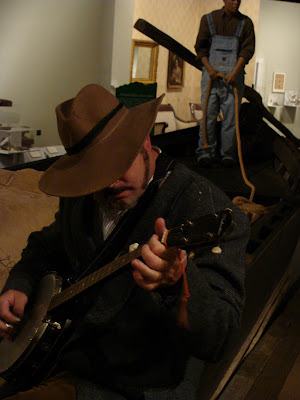

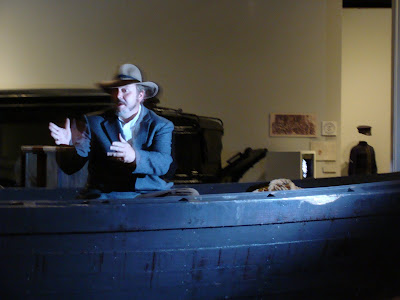
Here's a glimpse from dress rehearsel yesterday evening:


Tuesday, March 3, 2009
So what is this museum theatre stuff?

What is Museum Theatre? The Museum Theatre program is comprised of characters, real or fictionalized with short monologues written using primary and secondary sources, including newspaper reports, diaries, biographies, and oral histories. Performed in the Museum’s galleries, the program is designed to engage the visitor in a thought- provoking dialogue relating to the issues and events of the period and to give context to the artifacts and images on display.
Through the use of theatrical techniques, museum theatre brings to life the stories of people in the context of their era and draws upon primary sources to create characters that present history in an innovative and engaging manner. Museum theatre provides the opportunity to create an experience more conducive to various types of learners, and by giving a face to history makes learning more personal and relevant to visitors. Museums have turned to theatre as a successful medium for educating and enhancing the experience that happens within a museum.
New Program starts Saturday
The Augusta Museum of History is pleased to present the unveiling of a new program – Voices of the Past on Saturday, March 7, 2009. The program is a series of character monologues presented in museum theatre format, and is supported through grant funding from the Porter Fleming Foundation.
“The Augusta Museum of History is excited to offer such an imaginative and new approach in bringing local history to life for Museum audiences,” said Nancy Glaser, Executive Director of the Augusta Museum of History.
Voices of the Past begins with the performance, A Petersburg Boat Pilot, based on oral histories provided by Elberton, Georgia resident, Mr. ‘Buck’ Balchin, about his grandfather, James Henry Balchin, who from the mid-nineteenth century until 1900, crewed and piloted cotton boats from Petersburg to Augusta.
The premiere of the Augusta Museum of History’s museum theatre program will occur on Saturday, March 7, 2009. Performances times are 10:00 am, 11:00 am, and 1:00 pm.
“The Augusta Museum of History is excited to offer such an imaginative and new approach in bringing local history to life for Museum audiences,” said Nancy Glaser, Executive Director of the Augusta Museum of History.
Voices of the Past begins with the performance, A Petersburg Boat Pilot, based on oral histories provided by Elberton, Georgia resident, Mr. ‘Buck’ Balchin, about his grandfather, James Henry Balchin, who from the mid-nineteenth century until 1900, crewed and piloted cotton boats from Petersburg to Augusta.
The premiere of the Augusta Museum of History’s museum theatre program will occur on Saturday, March 7, 2009. Performances times are 10:00 am, 11:00 am, and 1:00 pm.
It's all about telling a story
 Robbie Pavey, the outdoor editor at our local newpaper (http://www.augustachronicle.com/) has always had a lifelong interest in history. He often will call over and ask museum staff to help pull research or images on a particular topic he's working on for articles - which we gladly do for all media, educators, students, etc.. as anyone in the general public can schedule an appointment for research purposes.
 Robbie contacted me last week and was interested in what life was like in the CSRA during the Great Depression. He met with Guy, our curator, and was able to go through our archives, looking at images from the time period. What resulted was a great article in the paper on Sunday, March 1 on poverty and joblessness in the Augusta area (read here at http://chronicle.augusta.com/stories/2009/03/01/met_513118.shtml)
Following Sunday's paper, Robbie received a phone call from a gentleman, Glover Addie Youngblood Jr, who was just an infant in the photo which appeared in the paper! The photo had been in our Archives for a number of years, and we did not have the names of the family in the photograph from the 1930s, but thanks to an article in our paper - we now have a story behind the picture!
Read more on Rob Pavey's blog at http://blogs.augusta.com/node/2343.
Tuesday, February 17, 2009
Artifact of the Day - Augusta Arsenal Box

I'd like to continue showcasing a few artifacts that maybe you don't notice as you walk through our galleries but contribute a great deal of value and importance to our region's history.
Above is an image of a Rifle Ammunition Box (1864) used at the Augusta Arsenal (present-day location of Augusta State University (www.aug.edu)).
This wooden box held 1,00 rounds or cartridges of ammunition for the Enfield riffle. Paper labels on each side of the box identify the contents of the box and are dated "September 1864". During the War, Augusta was one of the leading production sites for ammunition for the Confederacy, due to the Confederate Powderworks, located along the banks of the Augusta Canal (read more at www.augustacanal.com).
Some of the powder produced at the Powderworks was shipped "up the hill" to the Augusta Arsenal where it was used to make ammunition for firearms, grenades, rockets, and artillery.
Only three such ammunition boxes are known to exist. One of which is displayed in the Museum's permanent exhibit - Augusta's Story. Be sure to spot it in your next visit to the Augusta Museum of History!
Subscribe to:
Posts (Atom)


